

What is ‘misleading or deceptive conduct’?
A claim for misleading or deceptive conduct under section 18 of the Australian Consumer Law (the ACL) involves a four-step inquiry of the following:
1. the conduct said to contravene section 18 of the ACL;
2. whether the identified conduct was “in trade or commerce” under the meaning in section 2 of the ACL;
3. what meaning the impugned conduct conveyed; and
4. if that conduct, considering that meaning, was misleading or deceptive, or likely to mislead or deceive.
To assist this process, the court will also consider the conduct from the perspective of a reasonable person in the position of the person making the complaint, the matters of fact each party knew about each other as a result of the nature of their dealings, the commercial experience of the parties, and the clarity and prominence of any disclaimer(s).
Additionally, under section 4 of the ACL, a representation as to a future matter is misleading or deceptive unless the person making it can adduce evidence that they had reasonable grounds for making the representation.
The decision in United Petroleum
Background facts
On 6 July 2017, PAPL invited tender recipients to propose either a Building Lease (Top Lease) or Ground Lease for a service station on Airport Drive, Perth WA (the Site). The tender documents were provided to many prospective bidders, including United. A key selling point for the tender documents was that Qantas was expected to relocate all international and domestic flights from the Airport West Terminal to the Airport Central Terminal in the mid to late 2020s, as part of a broader consolidation of all commercial services into the new facilities at Airport Central, which would cause traffic volumes on Airport Drive to almost double (thereby significantly increasing the value of the opportunity on the Site). On 14 July 2017, PAPL emailed to United a document referred to as ‘Addenda 1’, which contained questions asked by tenderers and PAPL’s answers. Addenda 1 also annexed the Perth Airport design guidelines.
On 4 August 2017, United’s tender for the Site was submitted to PAPL. Two months later, on 22 November 2017, PAPL provided a lease proposal to United.
Further discussions took place at a meeting on 27 February 2018, where PAPL’s then-Chief Commercial Officer, Steve Holden, orally represented that the Qantas Relocation would occur “by 2025”. On 13 April 2018, the parties executed a Heads of Agreement for Sublease on 13 April 2018. An Agreement for Sublease (AFSL) was executed on 17 April 2019. The terms outlined that United leased the site for an initial term of 15 years from July 2020 at $900,000.00 per annum, with a 3% increase per annum until 2035.
United proceeded to design and construct the service station for a total cost of $7,721,182.67, called the “Millenium Concept” (pictured below). To this date, Qantas has not yet relocated, and recent agreements convey that Qantas’ mainline airline move has been postponed to “by 2031”.
The relief sought
United commenced proceedings against PAPL, claiming damages under sections 236 and 237 of the ACL, together with interest and costs, on the basis that PAPL had engaged in misleading or deceptive conduct by:
i. representing that Qantas would move from the Airport West Terminal to Airport Central Terminal, and consequently, that traffic volumes would double either “by 2025” or “by the mid to late 2020s”;
ii. PAPL’s omission by silence to disclose a series of matters which were material to the Qantas relocation representations, such as Qantas’ refusal to give a binding commitment to relocate by 2025, failing to mention that Qantas had not signed the commercial terms for the relocation, and PAPL’s failure to meet various internal milestones for the consolidation; and
iii. PAPL’s repeated representations of the Qantas Relocation by way of a press release and letter to United’s solicitors in 2020 (after United had executed the AFSL) further induced United to execute the formal Sublease on 17 May 2021 and consequently commence constructing the service station.
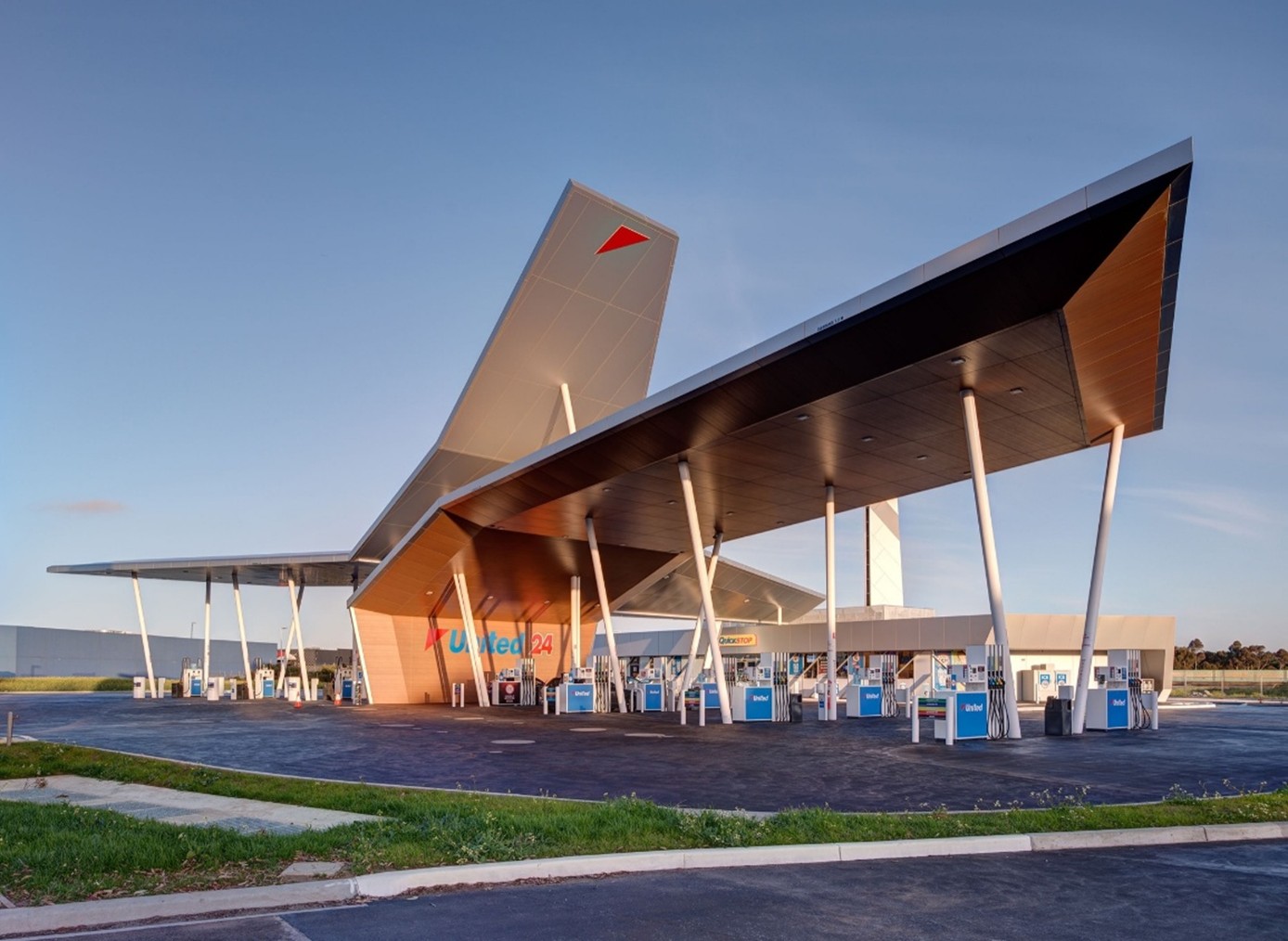
The “Millenium Concept” [Source]
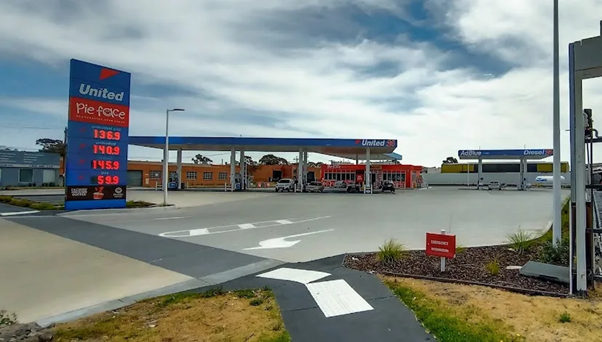
United Petroleum Cheltenham, Victoria [Source]
United’s loss case was ultimately advanced on an "alternative transaction" case; that, but for the misleading conduct, it would have leased a comparatively smaller site for $500,000 per annum and built a smaller, simpler service station based on an existing design in Cheltenham Victoria (pictured above), which would have cost approximately a third of what they spent on the “Millennium Concept” (pictured above) at the Site.
United accordingly claimed two heads of damage: excess rent over the 15-year initial term, and the excess cost of constructing the flagship Millennium Concept instead of the smaller design.
Findings
First and foremost, the Hon. Justice Anderson found that the misleading conduct lapsed upon execution of the AFSL, meaning the conduct to be considered was up until 17 April 2019 (at [34]). As such, United’s claim relating to the press release published on PAPL’s website in March 2020 and the letter from PAPL to United’s solicitors in August 2020 were not considered (at [434]-[435]).
In respect of the written representations within the Information Brochure and Addenda 1 included in the tender documents, the Hon. Justice Anderson gave fourteen (14) separate reasons as to why PAPL made representations or representations as to future matters (at [375]).
The Hon. Justice Anderson Gfound that PAPL promoted the Qantas Relocation as the reason traffic volumes would almost double, and was the only basis provided for the increased traffic volumes through the Site’s location. It was a key factor, and selling point, to the business opportunity that United successfully tendered for (at [384]).
The Hon. Justice Anderson likened PAPL’s conduct to a misleading marketing piece that entices the customer into a marketing web as was described at Australian Competition and Consumer Commission v TPG Internet Pty Ltd (2013) 250 CLR 640 (at [50]-[52]) in so far as the tender documentation included an Information Brochure enticing the prospective tenderer by accentuating the attractive prospects, and a Request for Proposal hiding the less attractive terms and conditions (at [338]).
Relevant to the Hon. Justice Anderson's findings was that PAPL confirmed it did not know when Qantas would relocate to the new terminal in Addenda 1, concluding that the denial to confirm when Qantas would relocate to the new terminal was not a denial that it would ever happen, but instead a denial of an agreed date, given the other representations (at [393]).
The Hon. Justice Anderson also found that considering what matters of fact United and PAPL knew about each other (citing Butcher v Lachlan Elder Realty Pty Ltd (2004) 218 CLR 592, [37]), it was reasonable for United to assume that PAPL operated Perth Airport and thus could rely on its representations about the consolidation and that Qantas relocation (at [389]).
Relief granted
The Hon. Justice Anderson awarded the excess rent claim, being the difference between the rent payable under the AFSL and the Sublease, and the rent United would have paid under the counterfactual over the 15-year initial term, with the 3% increase per annum until 2035 (though the final quantification is subject to further submissions on the time value of money) (at [611]).
The Hon. Justice Anderson also awarded the excess construction costs claim, being the difference between the actual cost of constructing the Millennium Concept service station and the estimated cost of constructing a smaller service station, being $2,649,381.99 (at [612]).
However, the Hon. Justice Anderson dismissed United's claim for misleading conduct by silence. He found there was no reasonable expectation of disclosure between sophisticated commercial parties dealing at arm’s length, particularly in the context of PAPL’s confidential negotiations with Qantas regarding the Qantas Relocation (at [521]-[525]).
Key takeaways
1. The Court recognised soft verbs like “expected,” “anticipated,” and “projected” may still attract section 4 of the ACL even if read in context as a forecast or prediction. Language referring to when something happens, or when something that will happen, or allusions to an expectation of an upcoming event, can, on its ordinary meaning, infer certainty even without an explicit timeframe, exposing PAPL to liability for misleading or deceptive statements.
2. The Hon. Justice Anderson recognised the well-established principle that contractual terms which require the contracting party to conduct their own inquiries do not absolve a party of liability for misleading or deceptive conduct. Those terms are part of the inquiry as to whether the impugned conduct was misleading or deceptive in all circumstances.
3. The Hon. Justice Anderson recognised the greater the information asymmetry between the parties, the less effective generic "make your own enquiries" clauses become, as there is often no enquiry the other side could realistically have made. Information asymmetry was thus a factor against PAPL when assessing whether the positive statements were misleading, though it did not give rise to a freestanding duty of disclosure.
4. The Hon. Justice Anderson held that the disclaimers lacked prominence in the document a tenderer would actually rely on for the commercial proposition, being the Information Brochure (as the RFP contained most of the disclaimers) (at [381]). This highlights the importance of ensuring that if an RFP or similar document is issued, any disclaimers, qualifications, and exclusions need to appear (or be expressly and prominently cross-referenced) in the document containing the representations themselves.
5. PAPL called four witnesses who all lacked the requisite involvement to give them grounds to make statements to future events under section 4 of the ACL. PAPL did not call the people who could speak to the commercial negotiations with Qantas (the chair, CEO, CFO, board members) (at [465]-[466]). When defending a misleading or deceptive conduct claim, then absent good reason, the actual decision-makers who made the representations relied upon ought to give evidence. Otherwise, the court may draw an adverse Jones v Dunkel (1959) 101 CLR 298 inference against the party who failed to call a witness who would naturally be expected to give evidence.
6. PAPL had agreements with Qantas containing “best-endeavours” commitments subject to commercial terms still to be agreed. The Hon. Justice Anderson found these documents did not constitute reasonable grounds to make a representation (at [464]). Where a forecast depends on a counterparty doing X, an unenforceable agreement to try to agree to X is not a sufficiently reliable foundation for representing a forecast as certain.
7. Internal documents that indicated doubt as to the relocation were central to the finding that PAPL did not have reasonable grounds to make their representations, as they contained candour from staff about the uncertainty of PAPL’s agreements with Qantas (at [502]-[505]). This demonstrates the litigation risk that exists where internal and external messaging contradicts each other.
In summary, this case is a useful reminder of the ACL’s unforgiving nature where a party issues optimistic marketing materials that do not reflect their actual state of knowledge, particularly when the issuer holds an information monopoly and the representations concern future events whose realisation depends on third parties.
Disclaimer
This article is provided for general information purposes only and does not constitute legal advice. It is not intended to be a comprehensive statement of the law and is limited to acommentary on the facts, issues, and principles arising in United Petroleum. The discussion should not be relied upon as applicable to othercircumstances.
If you require legal advice in relation to a claim of misleading or deceptive conduct, you should obtainindependent legal advice. The Watson Webb team have the expertise and experience to assist with any related enquiries.
.png)
.png)

.png)
.png)

.webp)


.webp)
%20(1).webp)
.webp)
.webp)



.webp)
.jpeg)


